Showing posts with label TOPS. Show all posts

Wednesday, 26 November 2014

What's the Calorie Count of Love?

You have had a really good week – you worked out a few times – you ate properly – you kept your portions under control – and you’re feeling pretty good.  Then the unthinkable happens …

… Your mom bakes your absolutely favourite cake and brings it over to have with coffee

… Your husband comes home with a treat from your favourite ice cream shop because HE had a craving

… Your friend (who can eat whatever he/she wants and never gain an ounce) offers to treat you to lunch at the newest food truck – the one with no salads on their menu

Sound familiar?

We’ve all been there!

Everyone’s intentions are good, but tempting a dieter with food or treats they know are forbidden is probably an unconscious act on their part.  Yet, when it happens, it can make it difficult when you are trying to stick to your diet.  We’ve discussed sabotage (intentional or not) by family and friends before so this time I want to focus on the worst culprit of all – the person you share you home with – your husband or partner.

While it may seem that your loved one is deliberately tempting you by bringing home that ice cream treat or you favourite donut, but experts say that their intentions are not as evil as you may think.  People who don’t have issues with food often do not realize the level of temptation that those of us on diets experience.

The most important thing to do is let them know how difficult it is when they lovingly offer temptation.  They need to understand that no one has an unending supply of willpower – and no matter how strong you are you cannot stare at fattening foods every day without your willpower breaking down.  Tell them not to bring you food as gifts – and nicely ask that they eat any calorie-laden food they may enjoy when you are not around to see, hear or smell it.

Even if your partner tries his/her best not to tempt you, there are many other reasons that you might gain weight when you are in a marriage/partnership.  Weight gain happens to men too, but since our TOPS group is all ladies at the moment and, with regards to weight gain in relationships the truth of the matter is – the female typically gains it. I am going to focus on why women gain the weight.

Why does it happen?

It’s more than just the “nesting-bulge”.  In a relationship where men and women are sharing the same space one does as the other does. When women start sharing meals with their husbands, eating habits change.  Some men might actually begin eating healthier; better balance meals, fruits, and veggies, while women might start eating LESS healthy – they begin to allow more junk food into the house and they start consuming larger portions, similar to those their partner’s are enjoying.  Portion judgement seems to go out the window.  With smaller muscle mass and body size, women don’t need as many calories to keep the body functioning.  When there is excess – weight gain is inevitable!

The phenomenon is very real and is called “Spousal Concordance”.  It happens more frequently in the
beginnings of relationships but can carry through the years, or begin at any point.  Are you an empty nester with only two mouths to cook for instead of more?  Did you or hubby recently retire and now you spend more time in each other’s company?  Spousal concordance is sneaky and you may not even be aware it’s happening … have you submitted to his Sunday TV binge-watching routine?  Joined his late-night taco runs?  When women spend more time at home with their mates, they tend to shift towards eating more and exercising less.  Beware of those upcoming fall and winter nights when the TV and ice cream seem very appealing. 

In the March 2010 issue of Women’s Health www.WomensHealthMag.com they offer some reason why the weight gain happens and how to get it back under control.

You match him bite for bite – it’s tough to stick to tiny portions when your partner downs 500 to
1500 more calories than a day than you do.  Women tend to develop “portion distortion”.  You don’t recognize a normal-size serving anymore because you are always eating with a guy who consumes huge platefuls of food.  He might be able to get away with it because men have more muscle mass, so they require more calories, but shovelling in all those extra forkfuls WILL eventually catch up to you.

How can you fix this?  It’s pretty basic!  Serve yourself less.  Eat about three quarters of what he’s eating.  Sorry, but women burn 26 percent fewer calories than men do, so at that rate you’ll break just about even.  It’s not fair but it is what it is … men lose weight faster then women too … can’t hate them for the cards Mother Nature dealt.

His snacks are your snacks – you might not buy chips for yourself, but when he leaves the bag out on the coffee table, you need supreme willpower to ignore it.  Believe it or not women are more likely to adopt their partner’s eating habits than vice-versa.  For some reason women feel that this is a way for them to “connect” with the men in their lives.

How do you fix this?  Know your options.  You have two diet-friendly choices.  Serve yourself a small amount of his snack and put it on a plate.  Dipping your hand into the bag over and over again leads to nothing but diet disaster.  Or, have a portion controlled, lower-calorie alternative on hand to munch while he takes down that bag of chips or pint of ice cream.  Pop Chips(120 calories per serving), with just three servings in a big bag can satisfy your salt craving, while hockey puck size Skinny Cow ice cream sandwiches (140 calories each) fill in nicely for fattening frozen desserts.  Who knows – you may even convert him!

If you eat out all the time – sometimes life gets busy and cooking a meal seems like one more thing you
have to do.  The easiest solution is to order in, grab something on the way home or go out to a restaurant.  That’s bad news for your waistline.  A study of 24 national chains revealed that the average entrĂ©e at a sit down restaurant contains 867 calories.  And that does not include Apps, sides, drinks and dessert.

How can you fix it?  Cook meals together.  Not only can it be some time that you can share together (food is a bonding experience) but also you can control the fat and calories by using healthy recipes and ingredients that are low fat.

You are always at home – with the kids, on the couch, in the kitchen – anywhere but at the gym.  A study by the Obesity Journal found that couples who live together for two or more years are less likely to be physically active, and the women are the ones more likely to become obese.  As positive as relationships can be, they also change your routine. 

How can you fix it?  Get him involved.  Women who exercised with a partner lost more weight than those who sweated it out solo.  When people do something together they are more likely to stick with it.  You don’t have to join a gym – just decide to go for a walk after dinner every night.  In a perfect rose-coloured world – when you don’t feel like going, he’ll drag you out, and you’ll do the same for him.

So – I guess love does come with calories.  But stop blaming you partner/spouse for your weight gain.  They are not forcing you to consume the food – you own that decision.  But, by the same token don’t be afraid to ask for help.  Love may have calories but it should also have understanding.  Adding a few extra pounds isn’t the really bad part.  Starting unhealthy habits is! 


If you both need to get back on healthier track, set small goals you can achieve together.  Commit to taking that 15-minute walk together, or forgo take-out (whether fast food or green juice) twice a week in favour of a home cooked meal.

If you partner does not want to or does not need to participate, nicely ask for his support 
of your efforts … and CARRY ON!


Tuesday, 16 September 2014

Things that make us go Hmmmm?

When I am looking for TOPS meeting topics, it is often confusing because of the massive amounts of information that are available at, quite literally, the tips of my fingers.  But how do you separate fact from fiction and the long-term advice that will serve you well over the long haul (because weight loss is a never ending battle, even if you are at your goal) from the latest fad that has popped up.  How do you believe what you read today when it seems to contradict what you read last week?  One week coffee is good for you – the next its not.  Last year eggs and dairy were the enemy and this year they are the best items to include on your list of healthy things to eat.

How do you wade through all the crap so that you can make wise and informed decisions that are not going to derail all your best efforts?

In a previous post I mentioned my accumulation of odds and ends about weight loss, specifically, and good health in general.  Each of the little bits of paper contains a nugget of information that is generally pretty good, thought provoking and interesting or sometimes, downright unbelievable.  All of the pieces sight authors, researchers, well-respected research facilities or doctors of one ilk or another.  None of the bits and pieces of scrap paper amount to a meeting topic in themselves, so I combined them to have a meeting I called “Hmmmm?”  Basically it was nothing more than an open discussion about the information and hopefully a consensus of “yes, I believe that” or “I’m not sure, but it couldn’t hurt” right down to “nope, I call BS”.

So, for your enjoyment (I hope) here are the “tidbits” that we discussed in our TOPS meeting.  I’ll include our general consensus on the item(s) but you make up your own mind … yeah!  maybe?  or BS.


So 250 food decisions ... our consensus was that this was very possible.  So with one decision down, here are 19 more to add to your total today.


Since we are all members of our TOPS group we all agreed that it was easier to stay on a healthy eating plan when you have friends or a group supporting you.  Our consensus … yes!


We all agreed that being informed about food choices and diet advice would be beneficial to staying on a diet.  Our consensus … being informed NEVER hurts.


 We were ambivalent on this one.  Those in our group who enjoy working out were adamant that it is an important part of any weight loss effort.  Those in our group who do not enjoy working out were relieved at the findings of the Brigham Young University Study but we all agreed that weight loss is the constant battle of calories in versus calories out (‘cause that has been drilled into our subconscious) so working out MUST be beneficial to losing weight.  The wording in the little blurb is deceptive though.  It states “researchers found that when it comes to KEEPING WEIGHT OFF” and that makes it sound like advice for someone who has already reached their goal weight.  We agreed that this advice might be accurate for, as they say, “KEEPING WEIGHT OFF”, but one needs to add exercise to the effort to get there!  Our consensus … this holds merit under certain circumstances.


 Sunlight is wonderful as a mood booster and being in a positive frame of mind certainly helps when one is trying to achieve any goal.  Our consensus … this advice falls firmly into the category of “couldn’t hurt” but one should not rely solely on sunshine to burn calories!


 Our group had the same feeling about this advice as the sunshine advice … a good mood certainly never hurts no matter what your endeavor.  We are all emotional eaters to some extent with some people eating more when they are happy and some people turning to food for comfort when they are sad or stressed.  Our consensus … yes, good advice!


 There is not doubt that the mind is a powerful thing and there is a reason we have the saying “mind over matter”, but unless you are The Amazing Kreskin, Uri Geller or David Copperfield “thinking the pounds away” is not going to whittle your waistline.  Our consensus on this one … we called BS!  (Note the honourable mention to deep breathing ... it comes up again later)


 It may not be possible to “think away pounds” but it is definitely possible to “think away cravings” by focusing on the positive outcome after making an eating decisions.  Our consensus on this one … absolutely yes, focusing on the upsides of resisting a craving will definitely “boost your willpower”.


We all liked this advice very much.  It is sound and made sense to all of us.  Focus on small attainable goals so as not to be overwhelmed by the scope of what you are trying to accomplish.  It also has built-in positive reinforcement.  Out consensus on this … definitely true!


 Everyone in the group seemed to remember a fitness program that was based on deep breathing exercises.  I personally remember trainers and coaches constantly talking about the concept of proper breathing.  Our consensus … proper breathing is important but don’t rely on deep breathing exercises alone to rev your weight loss …so, couldn’t hurt!


 We discussed how everyone backslides at one time or another and everyone has a cheat by indulging in a treat once in a while.  Our group agreed that any sensible eating plan is going to fail if you forbid yourself certain foods, so we agreed that if you simply cannot do without a treat you have to build it in to your eating plan.  The best piece of advice came at the bottom of the second article, “Bottom line: Be kind to yourself, even when you give in to a craving – it’s better than beating yourself up about it.”  Our consensus … everything can be part of a sensible eating plan in moderation so this was good advice.


 Some in our group have never played a video game and others (myself included) are recovering Bejeweled Blitz/Candy Crush/Jewel Star addicts so the whole get involved in a video game did not resonate.  We did all agree on the fact that focusing your mind on another activity or activity will definitely curb cravings (if it does not curb your “craving” then you need to consider the fact that you may actually be “hungry”).  Our consensus … good advice!


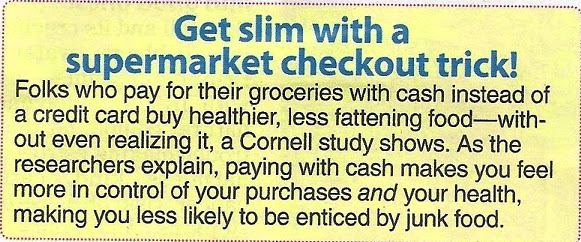
We all agreed that paying with cash makes you more aware of what you are purchasing because it limits the amount of “impulse items” you can throw into your shopping cart so you will stick to your shopping list and buy less.  We did not, however, agree that it would necessarily lead you to buy “healthier, less fattening food – with out even realizing it”.  Our consensus … not so much!

Well, that was all we had time for in our meeting, but we had a lot of fun and these little tidbits added some lively discussion to the meeting.  I think we’ll definitely being doing to again … which of course means there will be being posted here too.


Friday, 20 June 2014

Food Friday - TOPS Ten Under-appreciated Superfoods

I was flipping through some older TOPS magazines this week looking for some inspiration for a Monday meeting idea when I came across this TOPS Ten list of Under-appreciated Super Foods.  The topic seemed to go hand in hand with my blog post (meeting notes) from this past week, so I thought I’d share it here for this week’s Food Friday.

This list was published in the TOPSNews November 2011.

Beans


For centuries, many cultures have used these diminutive giants as a keystone for their cuisine.  Beans are nutritional superstars and an excellent source of protein and complex carbohydrates, as well as fiber and important vitamins and minerals.  Eating beans has been proven to help with lowering cholesterol levels, body weight, heart disease, hypertension, diabetes and some types of cancer.  Supplement you meal planning with any of the many varieties of beans that are available in fresh, frozen, canned, and/or dried form.

Celery


Do not overlook the many benefits and uses for this simple vegetable.  Celery contributes important vitamins, minerals and nutrients that can help reduce cholesterol and protect against cancer.  This easy-to-use vegetable is quite versatile and can be added quickly to your favourite dishes, including soups, stews, meat, side dishes, casseroles, and more.

Garlic

A very important bulb, there is much more to garlic than its characteristic flavour and fragrance.  Its anti-inflammatory and anti-oxidant phytochemical compounds protect against heart disease, reduce blood pressure, lower cholesterol levels, and provide anti-clotting activity.  Garlic should be a staple in every kitchen in order to add a supply of vitamins C and B6, manganese, and selenium to a variety of foods.

Onion


This seemingly old-fashioned, commonplace staple can be sliced, diced, chopped, pureed, and added to virtually any menu item requiring pungent flavour and a nutritional punch.  Enjoy the benefits of these bulbs, including fiber, minerals, and vitamins C and B6.  Scientists are still ascertaining onion’s polyphenol and sulfur-containing compounds that may reduce the risk of some cancers, as well as help boost immune function and heart health.

Peas


Meal plans rich in green and yellow vegetables (including green peas) have been associated with heart disease prevention.  No matter your favourite variety of peas (garden, snow, snap, dried, field, etc.), these plump gems are loaded with vitamins A, C, K, and B, minerals; fiber; and protein.  Peas are also a great source of eye-healthy compounds beta-carotene, lutein, and zeaxanthin.  Include peas in your favourite soup or stew, toss them into a salad, eat them as a side dish, or snack on them fresh from the garden.

Canned Tomatoes


This versatile food is a powerhouse of anti-oxidants, packed with good-for-you nutrients such as lycopene, Vitamin C, fiber, potassium, and iron.  Available all year long, keep some handy for enhancing pasta/rice dishes, soups, stews, casseroles, ethnic favourites, and side dishes.

Black Pepper

This unsung hero of the spice rack is simple, yet significant.  Black pepper adds no calories to your favourite dishes, but can noticeably enhance flavour.  Capsaicin – the substance that gives pepper its heat – is well known for its anti-cancer effects and the reduction of inflammation, which is a root of chronic disease.  Use and enjoy black pepper in its ground, cracked, and whole versions for variety.

I actually did a Friday Food post on the health benefits on black pepper over a year ago at http://mytwocaloriesworth.blogspot.ca/2013/02/food-friday-black-pepper.html

Sunflower Seeds


These nutty seeds are as intriguing as their large and cheerful flower.  They are a powerhouse of heart-healthy polyunsaturated oil, anti-oxidant vitamin E, protein, B vitamins, and important minerals such as manganese, magnesium, and selenium.  Sunflower seeds are also one of the best sources of phytosterols, a compound known to reduce blood cholesterol levels.  Add them to breads and salads, or enjoy them as a healthy snack.

Sesame Seeds *


Sesame seeds are one of the oldest condiments known to mankind.  Generations have benefited from the nutty, nutritious crunch they add to a variety of dishes.  These tiny treasures should be a staple in your pantry to supply your with large levels of important minerals, vitamins, protein, and fiber.  They also provide a flavourful source of cholesterol-lowering phytosterols and lignans.

Bell Pepper **

This singular food item comes in an array of vibrant colours, including green, red, yellow, orange and purple.  Remember that your meal plans should include veggies in a variety of colours for well-rounded health benefits.  Peppers are packed with powerful anti-oxideant vitamins and minerals, which can help lower cholesterol and reduce the risk of certain cancers.  Add sliced or diced, cooked or raw peppers to some of your favourite dishes to aid in the battle against cell-harming free radicals.

*****

The following was not part of the original TOPS article, but falls under the category of personal edification … otherwise known as …

How did I not know that?????

** I was curious as to any difference in nutrient values for the different colours of pepper.  The TOPS article seemed to imply that there were different nutrient levels in the different colours of peppers.  I always assumed they were the same and chose the various colours from “eye-appeal”.  Here’s what I found …


Bell peppers are members of the Nightshade family of vegetables along with potatoes, tomatoes and eggplants. Like chili peppers, bell peppers originated in South America where seeds of a wild variety are believed to date back to 5,000 B.C. The various colored Bell Peppers all come from the same plant, but differ in their level of maturity:

GREEN PEPPERS
Green bell peppers are harvested before they are fully ripe, one reason they are less expensive than other varieties. Green bell peppers will continue to first turn yellow and then red if they are left on the plant to mature. They have a slightly bitter flavor and will never have the sweet taste of their red, yellow and orange counterparts.

ORANGE AND YELLOW PEPPERS
More mature than green bell peppers, yellow and orange peppers have a fruity taste but are not as commonly found in local markets as green and red bell peppers.

RED PEPPERS
These are more mature than green, orange or yellow bell peppers. They are rich in carotenoid phytonutrients and contain almost eleven times more beta-carotene than green bell peppers as well as one and a half times more vitamin C. Red Bell Peppers have a sweet, almost fruity taste. Pimento and paprika are both prepared from red bell peppers.  There are also other varieties that have a more tapered shape and do not have the lobes characteristic of the green, orange yellow and red varieties.

The above information supplied by http://www.whfoods.com

** I like sesame seeds and I like sesame seed oil.  I never gave it a passing thought before but today I wondered where sesame seeds come from … so I checked it our and they DO grow on plants!  Why had this never occurred to me before?  They are seeds after all!  Oh the things I learn when I least expect it.


Monday, 9 June 2014

Less Fat -- More Flavor

This article appeared in the February/March 2014 issue of TOPS News magazine and although all members of TOPS receive the magazine, well uhm, let’s face it – we don’t always read all the articles.  I thought the information was good to share so I used it as the topic of our weekly meeting.


Jeanette Hurt writes the article.


Healthy doesn’t have to equal “tastes like sawdust”.  You can trim fat without sacrificing flavor.  Just use the following tips and you, too, can prepare delicious meals that are also good for you.


CUTTING FAT

 Up the veggies …

A simple, yet tasteful, technique to shed fat and calories is to increase the amount of vegetables a recipe calls for.  Instead of adding one cup of broccoli florets to your stir-fry, add two cups.  Add a half-cup more mushrooms to your pasta.  Every little bit increases good things – vitamins, minerals and fiber – while decreasing the overall fat and calories per serving.

You may need to slightly increase the cooking time or add a little bit more liquid to cook those extra vegetables – and a shake or two from your saltshaker – but you won’t have to add copious amounts of extra seasoning or oil when you just add more vegetables.

You can also add vegetables to recipes that don’t call for them.  Grate a half-cup of zucchini into your meatloaf; add mushrooms, cauliflower and broccoli to your mac and cheese; or toss in tomatoes with your tuna salad.  The secret to adding vegetables to things like meatloaf, meatballs and burgers is to grate and chop the vegetable very finely.  Sometimes, I first use the grating blade on my food processor, and then I puree the grated vegetables with its standard S-blade.  That way, no one can tell I’ve added veggies to my meatloaf.

Wipe don’t pour …


One of the problems when I’m cooking fast is I sometimes pour more oil into my pan than I want to.  Instead of pouring the oil directly into the pan, I pour a little bit onto a paper towel, and then wipe that across the pan.  Voila.  No more oil overload.

Heat the pan first …

I also heat my pan for one minute before I wipe the oil (carefully!), and then allow the oil to warm for 30 seconds to one minute.  That way, when I add my vegetable, meat or fish, the pan is hot and the oil is hot – so the food will cook more quickly and absorb less oil.  I also don’t end up adding more oil as the food cooks.


BOOSTING FLAVOR

 Use only new dried spices and herbs …


When you open a spice jar, you should get a big, big whiff of the spice – oregano, for example, should smell strongly like oregano.  If you only get a tiny sniff of spice, toss the jar.  You have to smell it – if it doesn’t smell wonderful then it’s no good.  Jeff King, a Chicago chef specializing in sausage making, says that adding old spices really is like adding sawdust to your foods – they don’t do anything good to your recipes at all.

Most dried herbs and spices only last for one year in your cupboards, and if you’re like me, you probably don’t use all of them up before they are past their prime.  I’ve learned to buy spices in smaller quantities – I either get the smaller jars, or I approach the bulk counter and measure out only a couple of spoonfuls.  By using dried spices and herbs that are fragrant, their flavors will really wake up foods.

Use fresh herbs when you can …


There’s nothing more aromatic than fresh herbs.  Even dried herbs don’t have that zing.  Because I use small amounts at any one time, I try to grow my herbs.  Some I grow in my garden, and I use them all summer and fall.  Others I grow in a pot, so I can have them ready to snip when I need them.

 And if you can’t get them fresh, get them frozen.  Many gourmet food stores sell frozen cubes of cilantro, basil and garlic.  But you can also make frozen cubes.  Simply take what fresh herbs you are not using, chop them in a food processor with a little water, and then pour into ice cube trays and freeze.  Place the frozen cubes in freezer-proof sandwich bags – and pop out a cube when you need a burst of flavor for your dishes.

Buy the best quality food you can afford …


When you use fresh foods, your recipes will taste better.  But buying fresh and good quality doesn’t have to equal expensive.  I’ve found good meats and vegetables at ethnic grocery stores, discount food stores and farmers markets.  In fact, I’ve shopped around to find the cheapest farmers market in my city (it’s not, unfortunately, the one in my neighbourhood!), and that’s where I buy my produce in bulk.

One of the challenges with buying fresh is making sure you use it before you lose it – or rather, before it goes bad in you icebox.  What helps my cut down on waste is that I try to prep my vegetables as soon as I get them home.  That way, on busy nights, I can grab things and make dinner in a hurry.

Roast your veggies …


To make your carrots taste like candy, to make your tomatoes sparkle like rubies, and to make your garlic soft and so, so garlicky – roast them.  Root vegetables especially taste great when roasted.  Simply preheat your oven to 350 degrees Fahrenheit.  Prep your veggies, and line them in a roasting pan.  Drizzle a little – and I mean only a little – extra virgin alive oil on the vegetables (one and a half teaspoons for five pounds of tomatoes, for example) and sprinkle salt and pepper on top.  Roast for one hour.